
Friday, October 24, 2014

Wednesday, October 22, 2014
Caesar's Palace Wants to Come To Manila
Could there be a Caesar's Palace coming to Manila? It might become a reality as the Caesar's Group expressed interest in coming to Manila's rising Entertainment City in the Pasay area. Even Caesar's CEO Gary Loveman, met with President Aquino to express his interest in doing a project in the Philippines.
The arrival of Caesar's Palace will certainly position Manila as an even more attractive gaming and entertainment hub as it tries to rival Macau and Singapore. Macau's rise and claim to fame further catapulted with the arrival of Sands and other big US Casino names such as The Venetian, Wynn and other brands.
While these are still in the talks, there is a good chance it could actually happen in the Philippines. Given Nobu's entrance into hospitality and opening a hotel in Entertainment City, it will certainly give the Caesar's group an idea of what to expect since the Nobu brand is also being developed by the Caesar's Group in Las Vegas.

Here are some recent media clips from the web:
Caesars Palace Wants In
http://business.inquirer.net/180604/biz-buzz-ortigas-new-calling
Ceasars Palace operator interested in putting up Philippine casinohttp://www.interaksyon.com/business/97757/ceasars-palace-operator-interested-in-putting-up-philippine-casino
Higher investment floor for new gaming investors eyed
The arrival of Caesar's Palace will certainly position Manila as an even more attractive gaming and entertainment hub as it tries to rival Macau and Singapore. Macau's rise and claim to fame further catapulted with the arrival of Sands and other big US Casino names such as The Venetian, Wynn and other brands.
While these are still in the talks, there is a good chance it could actually happen in the Philippines. Given Nobu's entrance into hospitality and opening a hotel in Entertainment City, it will certainly give the Caesar's group an idea of what to expect since the Nobu brand is also being developed by the Caesar's Group in Las Vegas.
Here are some recent media clips from the web:
Caesars Palace Wants In
http://business.inquirer.net/180604/biz-buzz-ortigas-new-calling
Ceasars Palace operator interested in putting up Philippine casinohttp://www.interaksyon.com/business/97757/ceasars-palace-operator-interested-in-putting-up-philippine-casino
Higher investment floor for new gaming investors eyed
http://business.inquirer.net/180728/higher-investment-floor-for-new-gaming-investors-eyed
Sunday, October 19, 2014
What Quezon City Could Have Looked Like

QUEZON CITY, Philippines – Quezon City was just about to turn 9 years old when it was declared the new capital of the Philippines on July 17, 1948. President Elpidio Quirino signed Republic Act No. 333, establishing the permanent seat of national government there, moving it from Manila.
Quezon City was chosen from among 16 sites across the country.
Republic Act 333 also created the Capital City Planning Commission, tasked to produce a master plan for the new capital city. The master plan, approved in 1949, shall "guide and accomplish a coordinated, adjusted, harmonious construction and future development" of Quezon City.
Architect Juan Arellano was appointed to head the commission. He has previously teamed up with fellow architect Harry Frost, along with Alpheus Williams and Louis Croft, to produce a master plan for Quezon City (known as the Frost Plan or the Frost-Arellano Plan). It was approved in 1941, two years after the city's birth in 1939. (FAST FACTS: Quezon City)
To mark the 75th founding anniversary of Quezon City on Sunday, October 12, here's a discussion on some features of the 1941 and 1949 master plans for the city, and what has happened to these plans since.
Constitution Hill
The centerpiece of the 1949 master plan is Constitution Hill, in what is now known as Batasan Hills. It was supposed to accommodate the edifices of all branches of government.
Three groups of buildings would consist the national government center at Constitution Hill. In the middle right, fronting the Plaza of the Republic, is the House of Congress, which would host both the Senate and the House of Representatives, plus a Hall of Fame (a memorial for heroes and patriots) and a Library of Congress.
To the right of the House of Congress would be the Palace of the Chief Executive, or the residence of the President of the Republic. To its left would be the Supreme Court, offices of the constitutional commissions, and other moderating constitutional bodies of government.
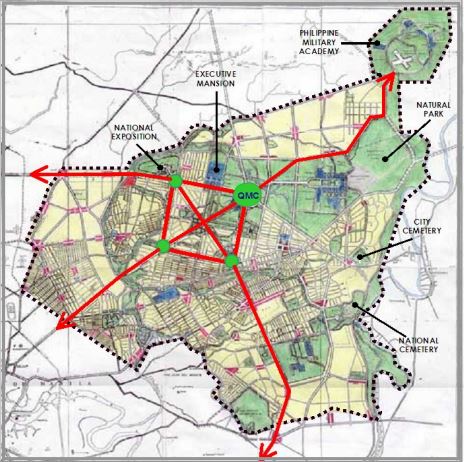 |
| In the 1941 Frost-Arellano Plan, however, the national government center was located in and around what is now the Quezon Memorial Circle. |
The legislature would conduct business in a Capitol building at the Circle, with the Executive Mansion or presidential palace to its left (in what is now the Veterans Memorial Medical Center or VMMC) and the Supreme Court complex to its right (the current site of East Avenue Medical Center).
Meanwhile, the current Batasan Hills in the 1941 plan was reserved for the Philippine Military Academy (PMA).
Currently, only the Batasan Complex stands in the planned Constitution Hill. Both the presidential Palace (Malacañang) and the Supreme Court complex remain in Manila.
Central Park/Diliman Quadrangle
Both the 1941 and 1949 master plans envisioned Quezon City as a "Garden City," providing for parks, greenbelts, and open spaces throughout.
A Central Park was at the "heart" of the park system in the 1949 master plan. It was situated at the Diliman Quadrangle, approximately 400 hectares, and bounded by the North, West, East, and South Avenues. It was devoted exclusively to park facilities and recreational activities.
The entire northern half of the Quadrangle was reserved for a botanical and zoological garden. The southwestern quarter was intended for a municipal golf course, while the southeastern quarter was where a national stadium and sports center was supposed to be built.
Sadly, the Central Park was never completely realized, as several proclamations and orders reduced the park's size numerous times.
Existing remnants of the Central Park, along with the Quezon Memorial Circle, are the 19-hectare Ninoy Aquino Parks and Wildlife Center and a "mini-forest" between the Central Bank of the Philippines and the Lung Center along East Avenue.
At the northeast corner of the Diliman Quadrangle is the Quezon Memorial Circle. Standing tall at the oval grounds is the Quezon Memorial Monument, erected in honor of President Manuel L. Quezon, from whom the city took its name. It was constructed from 1952 to 1978.
In the 1941 master plan, however, the oval was supposed to be the location of a proposed Capitol building for the Philippine Legislature.
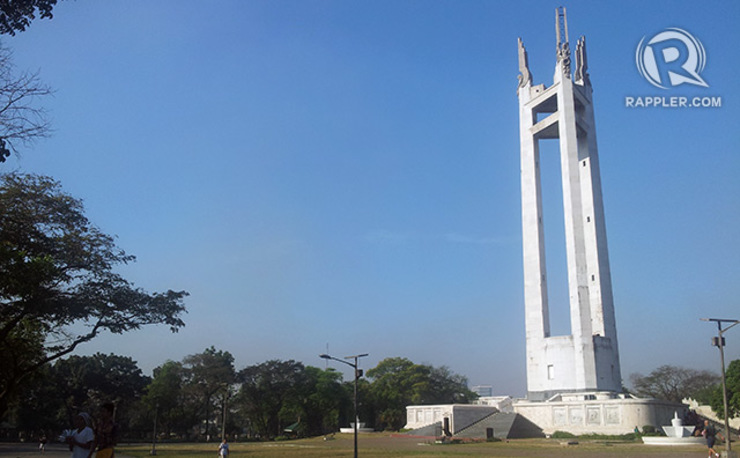 |
| The Quezon Memorial Monument. Michael Bueza/Rappler |
Meanwhile, in the 1949 master plan, a big building was proposed to be built there to house most (if not all) executive departments. The oval would be part of the Executive Center, which would also include portions of land on both sides of the oval.
The Quezon Memorial, on the other hand, was to be constructed on the left side of the oval, at the site where the VMMC now stands.
At present, the offices of the Department of Agriculture (DA) and the Department of Environment and Natural Resources (DENR) are located at the left side of the oval, while the Quezon City Hall Complex is at the opposite side.
Quezon City Hall
In the 1949 master plan, the Quezon City Hall was supposed to be at what is now the East Avenue Medical Center (the site of the Supreme Court complex in the 1941 plan). The plan also proposed a civic center – containing a public library, an auditorium, and a theater – near the city hall.
The present-day 14-storey Quezon City Hall building was constructed from 1964 to 1972.
National Exposition Grounds
Spanning 46 hectares, the National Exposition Grounds (on the left of today's VMMC, opposite the northwest corner of the Diliman Quadrangle) were provided for in both plans. It was planned as the venue for the 1946 World's Fair, according to architect and urban planner Paulo Alcazaren. Now, the SM City North EDSA complex can be located on that site.
In the 1949 master plan, a Scientific Government Center, intended for scientific bureaus like the Bureau of Plant Industry and the Bureau of Soils, was placed adjacent to the Exposition Grounds. Plus, the original Veterans' Hospital was supposed to be placed across the Exposition Grounds, on the left side of EDSA.
Business and Industrial Hubs
The 1949 plan also set up 4 major commercial centers:
- A 318-hectare business center in the metropolitan area (near Central Park and the Executive Center)
- A 80-hectare business center in the north district, near the La Mesa Watershed
- A 45-hectare business center south of Quezon City not far from Camp Crame; it is now known as the Cubao business district
- A 35-hectare central public market at the city entrance along Republic Avenue
Meanwhile, industrial zones were placed at the outskirts of the city in the northeast.


Republic Avenue
The 1949 plan also provided for a Republic Avenue, the "principal showplace" of the capital city. Stretching westward from Constitution Hill (to connect eventually to what is now Roxas Boulevard), Republic Avenue was supposed to be lined with a strip of parks on both sides. At the west end is a big rotunda, chosen to be the site of a War Heroes Memorial.
At present, however, Republic Avenue is only a road segment from Barangay Sauyo to Barangay Holy Spirit. There are moves to revive the original plan for Republic Avenue, but the intended path for the road is occupied by informal settlers, said the QC Planning and Development Office.
Other thoroughfares in the 1949 Master Plan
- EDSA, or at least the section passing through Quezon City, was to be calledLiberation Avenue.
- A Katipunan Parkway was supposed to encircle the entire city.
- The Santa Mesa Boulevard (now Ramon Magsaysay Blvd) was to be extended up to Marikina, and be known as Malaya Avenue.
- Congressional Avenue was supposed to stretch up to Constitution Hill. Now, it ends at Luzon Avenue.
- Luzon Avenue was supposed to be a circumferential road leading to San Jose del Monte in Bulacan.
- Visayas Avenue was also planned as a circumferential road connecting Meycauayan in Bulacan to Malaya Avenue. At present, Visayas Avenue starts at the Elliptical Road and ends at Tandang Sora Avenue.
- Mindanao Avenue was supposed to stretch from Ipo Road (now Quirino Highway) near the La Mesa Watershed to Liberation Avenue or EDSA. Now, two unconnected segments of Mindanao Avenue exist.
Quezon City was the nation's capital for only 28 years. The distinction was regained by Manila on June 24, 1976, when President Ferdinand Marcos signed Presidential Declaration No. 824. – Rappler.com
Sources: RAPPLER.COM "Quezon City Comprehensive Land Use Plan 2011-2030", Quezon City Planning and Development Office; "The Master Plan for the New Capital City", Capital City Planning Commission; "Quezon City: A Saga of Continuing Progress", Quezonian Newsletter; The 1946 Quezon City world's fair, Paulo Alcazaren; The International Garden Cities Exhibition Facebook page Original Link to the Article: http://www.rappler.com/newsbreak/iq/71703-revisiting-quezon-city-master-plans
Thursday, October 16, 2014
Philippines' BCDA maps out Economic Hubs

BCDA is mandated to convert former US military reservations into productive uses
to promote the development of Central Luzon. BCDA has been instrumental in developing Fort Bonifacio in Taguig and Camp John Hay in Baguio. BCDA is in the process of converting more areas around the country.
Tuesday, June 10, 2014

Thursday, February 13, 2014
Google Street View Philippines - Launch
Google Philippines has just launched Street View! I am thrilled that this project is finally happening. Anyone from any part of the world can now view the streets of the Philippines, starting in Manila - and even underwater in the Apo Islands. Its a wonderful way to document our, past and present and future urban environments. I'm sure we will appreciate seeing how our streets will evolve over the years.
When I look at old photographs of Pre-war or colonial Manila - I just melt at all the beautiful street scenes of people, buildings going about their daily lives, not knowing of what awaits the future of their city. When I walk along the old calles and avenues of Manila today, it's hard to picture that these very places were dignified streets. Many of these same streets have turned into crime-ridden, destitute, forsaken places. There is hope and I'm sure in time we will be able to recapture glorious moments and create our own history with the help of Google Street View.
Thursday, July 25, 2013
Flood Management Master Plan for Metro Manila and surrounding areas
On June 19, 2013 the DPWH released its report on the Flood Management Master Plan for Metro Manila and surrounding areas. Read more here
Objective:

Guiding principles for master plan development:
1. Adopt the principles of integrated water resources management and river basin approach
2. Develop a safe society with resiliency to floods through:
5. Strengthen community-based flood risk management—land use and solid waste
6. Utilization of runoff waters as water resources, etc.
7. Reforestation and watershed management
Three major flooding occurrences:
1. Huge volume of water coming from Sierra Madre
2. Drainage capacity constraints in core area of Metro Manila
3. Low-lying communities around Manila Bay and Laguna Lake
Read the rest of the report here
Objective:
After the flood events brought about by
typhoons Ondoy and Pepeng in September and October 2009, respectively,
that caused severe damage in Metro Manila and surrounding areas, the
World Bank has provided a technical grant in the amount of $1.5 million
under the Global Facility for Disaster Reduction and Recovery Trust Fund
of the Australian Agency for International Development (AusAID).
A flood risk assessment study for the
entire Metro Manila and surrounding basin area was undertaken from
February 2011 to February 2012, to prepare a comprehensive flood risk
management plan for the same and to determine a set of priority
structural measures, which will still undergo individual feasibility
studies and detailed design prior to implementation, including
nonstructural measures that will provide sustainable flood management up
to a designated safety level and serve as the roadmap/vision of the
government until 2035 (23 years from now).
Guiding principles for master plan development:
1. Adopt the principles of integrated water resources management and river basin approach
2. Develop a safe society with resiliency to floods through:
- Structural measures for the river basins and waterways
- Structural measures for the Laguna lakeshore, and
- Improvement of the urban drainage system
5. Strengthen community-based flood risk management—land use and solid waste
6. Utilization of runoff waters as water resources, etc.
7. Reforestation and watershed management
Three major flooding occurrences:
1. Huge volume of water coming from Sierra Madre
2. Drainage capacity constraints in core area of Metro Manila
3. Low-lying communities around Manila Bay and Laguna Lake
Read the rest of the report here
Sunday, June 23, 2013
NAIA Terminal 1 will finally get a Facelift! Cobonpue's design will push through!
Secretary Jun Abaya of the DOTC (Department of Transportation and
Communications) announced that it is moving forward with the P2.8
billion rehabilitation of NAIA terminal 1 with plans to bid out by next
month contracts to address structural and architectural components. In a
meeting held in the DOTC office on May 10, 2013, five cabinet
secretaries chose to adapt the original design of Kenneth Cobonpue,
Budji Layug and Arch. Royal Pineda for the long-awaited rehabilitation
of NAIA-1. Present during the meeting were DOTC Sec Emilio Abaya, DOF
Sec Cesar Purisima, DPWH Sec Rogelio Singson, DOT Sec Ramon Jimenez Jr.,
Cabinet Sec Rene Almendras, MIAA Gen Manager Jose Angel Honrado and
National Competitiveness Council Co-chairman Guillermo Luz.
Shelved in 2011, the original plan revolves around a green oasis in the heart of the city surrounded by several road rings flanked by a multi-level parking building and a greeters terminal. Sec. Abaya said that the trio would put a “Filipino taste and modern feel” to the planned rehabilitation, with Sec. Jimenez saying that the “aha feel” in the proposed design was what they were looking for. Targeted for completion in time for the hosting of the APEC Summit in 2015, the design complements the original exterior which, due to national patrimony laws, cannot be altered. The trio will work with the architectural firm of Leandro V Locsin who designed the present NAIA terminal.
The "dream" NAIA as envisioned by the team of Kenneth Cobonpue, Royal Pineda and Budji Layug with the NAIA PMO:
Videos from 2011 Special on ANC: Redesigning NAIA Terminal 1
Shelved in 2011, the original plan revolves around a green oasis in the heart of the city surrounded by several road rings flanked by a multi-level parking building and a greeters terminal. Sec. Abaya said that the trio would put a “Filipino taste and modern feel” to the planned rehabilitation, with Sec. Jimenez saying that the “aha feel” in the proposed design was what they were looking for. Targeted for completion in time for the hosting of the APEC Summit in 2015, the design complements the original exterior which, due to national patrimony laws, cannot be altered. The trio will work with the architectural firm of Leandro V Locsin who designed the present NAIA terminal.
The "dream" NAIA as envisioned by the team of Kenneth Cobonpue, Royal Pineda and Budji Layug with the NAIA PMO:
Videos from 2011 Special on ANC: Redesigning NAIA Terminal 1
Wednesday, June 19, 2013
Another "Green" development comes to Metro Manila.... watch out Mandaluyong City
Another "Green" development comes to Metro
Manila...
We have Greenmeadows, Greenhills, Green Residences, Greenbelt, Circulo Verde (Green Circle)...did we miss anything? Oh and now...GREENFIELD DISTRICT!
I guess it is Metro Manila's way of making up for the lack of green space. Don't be fooled by all the "Green developments" in the city. But sad as it may be, it is true that these places have some of the few places where people can relax and enjoy green spaces. Of course the first three are residential "villages"...and a tower while the rest are mixed-use developments.
In the early 1970s, a budding developer and landholding company by the name of Greenfield Development Corporation established its modest beginnings with the construction of EDSA Central.
Located at the heart of the metropolis, the mixed-use development rapidly grew into a bustling hub for commerce and transportation.

Forty years later, the former congested complex is now being transformed by the same company into a master planned community with a “smart and connected” promise, dubbed as the Greenfield District.
“Greenfield is setting its sights towards revolutionizing living in Mandaluyong.
“Through the smart and connected blueprint of the Greenfield District, we aim to help recreate the city into a state-of-the-art urban center that measures up to the highest urban planning standards in the world,” said Jeffrey D.Y. Campos, Greenfield Development Corporation’s president and chairman of the board.
Greenfield District will be the first of its kind in the Philippines, offering a balance between modern comfort and green living with state-of-the-art buildings and natural wonders.
Infrastructure components are designed to let the environment work for its end users. Intelligent building, property, energy, waste and water management practices are strictly observed and implemented and connected via integrated network operation centers.
At least forty percent of the planned hub will feature pocket parks, tree-lined roads and verdant open spaces. In addition, the proposed district’s central location in Mandaluyong and its direct access to EDSA makes it conveniently located near other l business districts, schools, hospitals, malls and lifestyle centers.
Greenfield District will also feature BPO offices, shopping buildings and a wide range of bars and restaurants, all of which will be connected through pedestrian-friendly walkways. Interconnected underground parking spaces and roads will also be built for easier vehicular navigation.
Its first vertical residential development, Twin Oaks Place, is a showcase of Greenfield’s plans and standards for future buildings in the Greenfield District. Outfitted with Fiber-to-the-Home (FTTH) technology, Twin Oaks Place will enable residents to enjoy the convenience of a smart and automated home, as well as connection speeds of up to 1GBps.
The first tower is set to be completed in early 2014. This state-of-the-art structure, Campos says, is a promise of bigger and brighter things to come.
With its focus on future-ready structures, Greenfield is hoping to pave the way for the next generation.
Campos concludes, “Through innovation and quality, we aim to bequeath a legacy of fully connected, balanced and sustainable communities”.
Quiet Moving Force in the Industry
“Modesty aside, since our incorporation in 1961, we have remained a quiet moving force in the real estate industry,” Campos said.
Campos said that In its 50-year history, Greenfield has played an instrumental role in the development of Sta. Rosa by laying the groundwork for projects like Greenfield City, the first city within a park; Paseo, the outlet hub of the South; Pramana, the country’s first residential park, and several interchanges on the South Luzon Expressway.
The company has provided the foundation for joint venture projects including Ayala Greenfield Estates in Laguna, and Hillsborough Estates in Muntinlupa.
Today, armed with our vast pool of significant landholdings and resources, Greenfield is embarking on a new corporate direction. “We are setting our sights beyond the next fifteen years and building for the next generations through innovative and future-ready developments,” said Campos.
Source: Manila Standard Today
We have Greenmeadows, Greenhills, Green Residences, Greenbelt, Circulo Verde (Green Circle)...did we miss anything? Oh and now...GREENFIELD DISTRICT!
I guess it is Metro Manila's way of making up for the lack of green space. Don't be fooled by all the "Green developments" in the city. But sad as it may be, it is true that these places have some of the few places where people can relax and enjoy green spaces. Of course the first three are residential "villages"...and a tower while the rest are mixed-use developments.
"Greenfield Aims to Recreate Mandaluyong City"
In the early 1970s, a budding developer and landholding company by the name of Greenfield Development Corporation established its modest beginnings with the construction of EDSA Central.
Located at the heart of the metropolis, the mixed-use development rapidly grew into a bustling hub for commerce and transportation.

Forty years later, the former congested complex is now being transformed by the same company into a master planned community with a “smart and connected” promise, dubbed as the Greenfield District.
“Greenfield is setting its sights towards revolutionizing living in Mandaluyong.
“Through the smart and connected blueprint of the Greenfield District, we aim to help recreate the city into a state-of-the-art urban center that measures up to the highest urban planning standards in the world,” said Jeffrey D.Y. Campos, Greenfield Development Corporation’s president and chairman of the board.
Greenfield District will be the first of its kind in the Philippines, offering a balance between modern comfort and green living with state-of-the-art buildings and natural wonders.
Infrastructure components are designed to let the environment work for its end users. Intelligent building, property, energy, waste and water management practices are strictly observed and implemented and connected via integrated network operation centers.
At least forty percent of the planned hub will feature pocket parks, tree-lined roads and verdant open spaces. In addition, the proposed district’s central location in Mandaluyong and its direct access to EDSA makes it conveniently located near other l business districts, schools, hospitals, malls and lifestyle centers.
Greenfield District will also feature BPO offices, shopping buildings and a wide range of bars and restaurants, all of which will be connected through pedestrian-friendly walkways. Interconnected underground parking spaces and roads will also be built for easier vehicular navigation.
Its first vertical residential development, Twin Oaks Place, is a showcase of Greenfield’s plans and standards for future buildings in the Greenfield District. Outfitted with Fiber-to-the-Home (FTTH) technology, Twin Oaks Place will enable residents to enjoy the convenience of a smart and automated home, as well as connection speeds of up to 1GBps.
The first tower is set to be completed in early 2014. This state-of-the-art structure, Campos says, is a promise of bigger and brighter things to come.
With its focus on future-ready structures, Greenfield is hoping to pave the way for the next generation.
Campos concludes, “Through innovation and quality, we aim to bequeath a legacy of fully connected, balanced and sustainable communities”.
Quiet Moving Force in the Industry
“Modesty aside, since our incorporation in 1961, we have remained a quiet moving force in the real estate industry,” Campos said.
Campos said that In its 50-year history, Greenfield has played an instrumental role in the development of Sta. Rosa by laying the groundwork for projects like Greenfield City, the first city within a park; Paseo, the outlet hub of the South; Pramana, the country’s first residential park, and several interchanges on the South Luzon Expressway.
The company has provided the foundation for joint venture projects including Ayala Greenfield Estates in Laguna, and Hillsborough Estates in Muntinlupa.
Today, armed with our vast pool of significant landholdings and resources, Greenfield is embarking on a new corporate direction. “We are setting our sights beyond the next fifteen years and building for the next generations through innovative and future-ready developments,” said Campos.
Source: Manila Standard Today
Wednesday, April 24, 2013
Cities Alliance in Action - New Urban Planning Strategies for the Philippines
| CITIES ALLIANCE IN ACTION |
| New Urban Planning Strategies for the Philippines |

|
The Philippines ranks among the most rapidly urbanising
countries in the world. Currently, more than 60 per cent of its
population lives in cities and this figure is expected to rise to 70 per
cent by 2020.
While such rapid urbanisation creates new economic opportunities for cities and their residents, it is also characterised by rising poverty, housing constraints, environmental degradation and unemployment. There is immense pressure on Local Government Units (LGUs), who often lack the institutional and technical capacity to adopt a sustainable and strategic urban planning approach. For more than a decade, the Cities Alliance has supported the Philippines’ City Development Strategy programme in three phases, in partnership with the League of Cities of the Philippines (LCP). Helping Cities Help Themselves City of San Fernando, La Union: Botanical Garden City, a Healthy City, and a Springboard for Regional Progress Iliolo City: The Growth Centre for Sustainable Business, Industry, Tourism, Social and Human Development... These are just two of 63 vision statements formulated and implemented by as many cities across the Philippines as part of a strategic approach to urban planning and management, the City Development Strategy (CDS). In 1998, CDS 1: Preparatory Activities for the Expansion of CDS Programme in the Philippines was piloted in seven cities across the Philippines. Three years later, 31 new cities joined phase 2 of the programme, the CDS 2: Upscaling Poverty-Focused CDS in the Philippines. By 2006, another 15 cities took part in phase 3, CDS 3: An Enabling Platform for Good Governance and Improving Service Delivery. Today, the CDS is widely recognised as one of the most effective tools for strategic urban planning in the Philippines. Its flexible nature allows each city to identify unique challenges and development opportunities. Every city has its own long-term vision statement and a concrete plan of action against which progress is closely monitored. At every stage, stakeholders (including civil society, businesses, academia, local government officials and city residents) interact and exchange information and knowledge, making the CDS a truly participatory process. Beyond the Halfway Mark – and Counting Across the Philippines, response to the CDS has been extraordinary. To date, more than half of its cities have voluntarily participated in the programme , and the demand continues. Few countries in the world have seen such a high rate of participation in the CDS as the Philippines. This enthusiasm arises from the potential benefits associated with the programme. For instance, participating cities are seen as attractive financial destinations by international donor agencies and private investors. Also, CDS cities are encouraged to be efficient and resourceful in fundraising and allocation. This is critical since funding for the CDS in the Philippines is thinly distributed among a large number of cities.(1) The fiscal prudence of CDS cities has other advantages as well. Congressman Mel Sarmiento, a former Mayor of Calbayog City, explains: “CDS cities stand out in terms of their design and programmes. The transformation, but more importantly the institutionalisation of this transformation, is evidenced by the fact that CDS cities are those who are often recognised by award-giving bodies like the Galing Pook Award and National Competitiveness Council.” The CDS programme has also led to knowledge sharing through online platforms, workshops, city-to-city tours and other activities for city mayors and staff. For instance, based on information gathered from other CDS cities, Iliolo City implemented a house-numbering system which was not initially part of its CDS. Mary Jane Ortega, former Mayor of City of San Fernando, La Union says, “While CDS taught cities to compete it also taught us to share. This sharing tightened the bond between cities.” Ortega also highlights that this knowledge sharing has led to a replication of the CDS programme beyond the city level. She says, “Our city shared the CDS process at the barangay (village) and municipality level in our province.” This replication has occurred in other provinces as well. Lessons Learned from the CDS Success Story The scale at which the CDS programme operates in the Philippines is a testimony to its success. From the outset, the active participation and commitment of mayors and city officials have proved critical. Constant efforts are required to ensure their continued support. In particular, new mayors must be engaged and oriented with the CDS so that political support for it continues despite regime change. Led by mayors who serve as ‘champions’, many cities in the Philippines have locally institutionalised the programme to an extent that it works harmoniously with existing planning frameworks such as the Comprehensive Development Plan (CDP) and Comprehensive Land Use Plan (CLUP). However, the CDS has not yet been incorporated in national policy-making. This must be addressed in order for the CDS projects to be aligned with the development priorities of both, city and country. Finally, CDS cities in the Philippines can benefit from robust mechanisms to monitor socio-economic progress as a result of the programme. This has implications for project monitoring and evaluation and contributes to the ability of the Cities Alliance and LCP’ to identify and support CDS cities which need further attention.
(1)
With so many cities participating in the Philippines CDS programme,
there is a resource dilution. For instance, under CDS 2 and 3, each CDS
city received approximately USD 24,000 from the Cities Alliance. This is
in stark comparison to the Vietnam CDS programme, in which each of the
two participating cities received USD 125,000.
© 2013 The Cities Alliance, All Rights Reserved.
|
|

Friday, February 22, 2013
68th Anniversary of the Battle of Manila

Urbanismo Filipno remembers the Battle of Manila on its 68th Anniversary February 3-March 3
Check out special content shared by the Philippine Government with pictures and videos of horrific scenes that devastated our city and our heritage. The glorious city of Manila, dubbed the "Pearl of the Orient" had been reduced to ash and dust from World War II.
Check out:
http://malacanang.gov.ph/battle-of-manila/
Check out special content shared by the Philippine Government with pictures and videos of horrific scenes that devastated our city and our heritage. The glorious city of Manila, dubbed the "Pearl of the Orient" had been reduced to ash and dust from World War II.
Check out:
http://malacanang.gov.ph/battle-of-manila/
Through an exclusive partnership with Tiger Films, we [Malacañang Palace] are making available a rare, colored film featuring the devastation of Manila in the aftermath of the Battle of Manila. The footage, shot on Kodak colour film, showcases the extent of the destruction on the city of Manila, which was the second most devastated Allied capital of World War II.

Tuesday, February 19, 2013
Ortigas unveils Industria mall
MANILA, Philippines - Quezon City mall-goers will soon have a new
place to dine and shop in as premiere property developer Ortigas &
Co. unveils Industria.
In a statement on Tuesday, February 19, Ortigas said the P400 million-worth mall with a total leasable area of 14,000 square meters will feature an indoor-outdoor retail concept.
The new complex is expected to become the neighborhood commerical center for Circulo Verde, a P25-billion flagship residential development of Ortigas & Co., composed of 15 towers, located along Calle Industria in Quezon City.
"The name Industria alludes to the roots and legacy of the site. It has reference to the adjacent street ‘Calle Industria.’ The architecture of the proposed development also relates to industrial design elements," said Ortigas & Co. Shopping Center Division General Manager Cathy Casares-Ko.
It is designed to be a hang-out place for Circulo Verde’s residents as well as a young, edgy, and artsy crowd. It will be accessible to the public via two main entrances.
One access point is located along Calle Industria, and an alternative access bridge linking Circulo Verde to Amang Rodriguez is being developed.
It aims to have mix of tenants composed of a neighborhood grocery, unique gastronomic concepts, a fitness center, weekend markets featuring organic choices, as well as craft fairs.
It is also envisioned to be a venue for street art shows and music festivals. A special section of Industria, called the Lab, will house novel concepts in arts, culture, and design.
The new mall is expected to be fully completed in the first quarter of 2014, while the anchor supermarket should be ready by December 2013.
Industria will be the newest addition to the company's other retail developments, like Tiendesitas, Greenhills Shopping Center, and Estancia at Capitol Commons.
"Ortigas’ retail developments each have very distinct characteristics. While people flock to Greenhills Shopping Center for bargain finds, Tiendesitas for all-Filipino goods, and soon Estancia for high end destination retailers, the young and artistic personality of Industria would make it a haven for individuals who are looking for alternatives in food, fashion, and entertainment," Ko said.
The launch of Industria is the new addition to these ongoing projects of the Ortigas group:
- Rappler.com
-----------------------
It would be great to see more development projects pay homage to the local surroundings and heritage of the community they are building in. As a developer, you must understand the context of where you are building these urban spaces, keeping in mind the urban design and its connection to the greater fabric. This projects seems very promising...although...another retail mall? The Philippine economy is based on local consumption and it seems as though there will always be demand for these spaces as the population continues to grow, especially if this development is trying to attract the yuppie and artsy segment of the population.
 |
| Industria is the latest retail development venture of Ortigas & Company. Photo courtesy of Ortigas & Company |
In a statement on Tuesday, February 19, Ortigas said the P400 million-worth mall with a total leasable area of 14,000 square meters will feature an indoor-outdoor retail concept.
The new complex is expected to become the neighborhood commerical center for Circulo Verde, a P25-billion flagship residential development of Ortigas & Co., composed of 15 towers, located along Calle Industria in Quezon City.
"The name Industria alludes to the roots and legacy of the site. It has reference to the adjacent street ‘Calle Industria.’ The architecture of the proposed development also relates to industrial design elements," said Ortigas & Co. Shopping Center Division General Manager Cathy Casares-Ko.
It is designed to be a hang-out place for Circulo Verde’s residents as well as a young, edgy, and artsy crowd. It will be accessible to the public via two main entrances.
One access point is located along Calle Industria, and an alternative access bridge linking Circulo Verde to Amang Rodriguez is being developed.
It aims to have mix of tenants composed of a neighborhood grocery, unique gastronomic concepts, a fitness center, weekend markets featuring organic choices, as well as craft fairs.
It is also envisioned to be a venue for street art shows and music festivals. A special section of Industria, called the Lab, will house novel concepts in arts, culture, and design.
The new mall is expected to be fully completed in the first quarter of 2014, while the anchor supermarket should be ready by December 2013.
Industria will be the newest addition to the company's other retail developments, like Tiendesitas, Greenhills Shopping Center, and Estancia at Capitol Commons.
"Ortigas’ retail developments each have very distinct characteristics. While people flock to Greenhills Shopping Center for bargain finds, Tiendesitas for all-Filipino goods, and soon Estancia for high end destination retailers, the young and artistic personality of Industria would make it a haven for individuals who are looking for alternatives in food, fashion, and entertainment," Ko said.
The launch of Industria is the new addition to these ongoing projects of the Ortigas group:
- Greenhills Shopping Center which is undergoing a P25-billion redevelopment project, which is now on its 2nd phase;
- Tiendesitas which is going through a redevelopment process that will make it bigger by 20,000 sqm and cooler; and
- The construction of Estancia at Capitol Commons is well underway, with the mall set to open by 2014.
- Rappler.com
-----------------------
It would be great to see more development projects pay homage to the local surroundings and heritage of the community they are building in. As a developer, you must understand the context of where you are building these urban spaces, keeping in mind the urban design and its connection to the greater fabric. This projects seems very promising...although...another retail mall? The Philippine economy is based on local consumption and it seems as though there will always be demand for these spaces as the population continues to grow, especially if this development is trying to attract the yuppie and artsy segment of the population.
Sunday, February 17, 2013
'Paradores' en Filipinas
At least five major private-public partnership projects have been offered to Spanish firms to enhance the tourism and cultural agenda in Intramuros.
Intramuros Administration chief Jose Capistrano Jr. announced during the 6th Tribuna España-Filipinas at the Asian Institute of Management today that a master plan for the walled city has been finished, but “we (now) need to work on Phase 2 of the Master Plan which is a more detailed planning. After that, we can come up with a [terms of reference] for this package.”
Among the projects that are being developed are the establishment of a boutique hotel, fine dining restaurant, a theme park replicating the Old Intramuros, integrated parking and the Maestranza Park, which will be open to the public on February 11.
He said the long-term plan, which should be implemented by 2016, is the establishment of a row of cafes, shops and restaurants similar to Clark Quay in Singapore.
‘Paradores’
He also noted that the Department of Tourism is implementing programs for the restoration and conversion of 27 lighthouses in different parts of the country for “bed and breakfast” inns, similar to the Paradores chain of hotels in Spain.

Spain Tourism Attache Angela Castaño said Paradores are old structures like historical buildings, castles and chateaus developed and refurbished as hotels with modern services, the first of which was established in 1928. There are currently 98 Paradores operating in Spain.
“The bidding will be open to all (interested developers and investors). What is important is that we finish the terms of reference under our private-public partnership plan and then we bid it out to developers but that would mean a further study,” Capistrano said.
Visiting Permanent Secretary Luis Ramon Enseñat said the two countries should now work together because of their shared history. Enseñat is with the Ministry of Education, Culture and Sports of Spain. For his part, Instituto Cervantes Sec. Gen. Rafael Rodriguez-Ponga pressed for education in bridging the gap between the two countries.
“With 500 million Spanish-speaking people in the world, and 50 million in the US and 40 million who speak Spanish everyday, learning the language helps the young professionals improve their job opportunities. This goes beyond historical relations, it is not just about bridging the gap to the past but also charting the pathway to the future,” he said.
“We should recognize that relationships between the Philippines and Spain, whether it be in stone or paper, is working for the future of both countries,” he added. (ABS CBN)

Town of Vigan - UNESCO World Heritage Site - Best Preserved Hispanic Colonial Towns
The Plan to have 'Paradores' around the Philippines is a wonderful idea. I hope the government can formalize legislation and policies such as tax incentives and preservation standards to attract private investors who interested in rehabilitating, and creating value out of these under-utilized structures. Historic preservation-wise, it will save a lot of these structures from demolition and will contribute to the patrimony of the Filipino.
These Paradores will help stimulate local economies, create jobs and supply the demand of the burgeoning hospitality industry in the Philippines. Philippine policy-makers should really take this seriously and make it a priority for the preservation of Philippine heritage and also would enhance ties between Spain and the Philippines. I support the creation of PARADORES in the Philippines.
-- J.G. Apelar
Monday, February 11, 2013
Journal Article: Colonial Urban Planning and Land Structures in the Philippines 1521-1898
 Pilar Chias y Tomas Abad, 2012
Escuela de Arquitectura, Universidad de Alcalá
Madrid, España
Abstract: The Spanish Colonial period in the Indies extends from 1492 to 1898, when last colonies - Cuba, Puerto Rico, and the Philippines - attained their independence. The Philippines depended on the Spanish Crown from 1521, the date of the first settlement on the island of Cebu. More than 200 new cities were founded along the archipelago with the traditional grid structure, but some with other urban typologies have not been studied before. At the beginning they were mostly located on the coast and later became port cities, but the ensuing exploration of inland territories led to the construction of new settlements, later linked through a network of roads, railroads, and navigational routes. Based upon the ancient cartography of the Philippines that the authors recently discovered in the principal Spanish repositories, the present article studies the unexplored and unpublished fields of research, analyzing the different urban patters, as well as the territorial structures that were consolidated during the Spanish Colonial period in the Archipelago.
Journal Article: Click Here
Keywords: spanish colonies, urban typology, land planning, Philippine Islands, Islas Filipinas, ancient cartography
Thursday, January 31, 2013
Conservation master plan to breathe life into Intramuros
Conservation master plan to breathe life into Intramuros
A MASTER plan to redevelop and conserve Manila's historical walled city of Intramuros will spawn a river promenade, theme parks, boutique hotels, museums, theatres and other attractions.

Though details are not yet known, TTG Asia e-Daily understands that the restoration project will be open to private investors. Meanwhile, Augusto Rustia, chief, Cultural Properties and Conservation Division of the Intramuros Administration, said some components of the master plan are already underway.
Maestranza Park, facing Pasig River, will have a promenade, a dock for river cruises, cafes, restaurants, shops and exhibition areas, patterned after Singapore’s Clarke Quay. The reconstruction of San Ignacio Church also started this year to make way for an ecclesiastical museum, which will house 7,000 artifacts.

Other developments include the conversion of the former Ateneo Municipal School into a boutique hotel and the transformation of the space along Santa Lucia Gate into a small-scale theme park of Old Manila’s historical landmarks, similar to Madurodam in The Hague. The American Barracks will also house an American colonial period museum.

Rustia, whose department is being consulted for the master plan, said he would like Intramuros’ restoration to include more features, such as the revival of the Rajah Sulayman Theater and the art performances in Puerto Real.
However, he lamented that there was a lack of funds and conservation was not a priority in the country.
- Rosa Ocampo, TTG Asia
Sunday, January 20, 2013
Philippines Call-Center Capital of the World
"The Philippines is emerging as a great outsourcing nation for cost efficiency, but are there limits to its success?" || Aljazeera
Saturday, January 12, 2013
Real estate development along the Pasig River
Looking at aerial
maps of Metro Manila, you find very few large open tracts of land,
parks, or any green spaces at all. If there is green space, its
privately owned and is closed of to the general public. One of the few
open tracts of land in the heart of the urban metropolis sat the Santa
Ana Race Track in Makati. It is now being developed into a new
entertainment hub in Makati called The Circuit by AyalaLand - a
mixed use district with parks, open space oriented towards the Pasig
River with an entertainment mission behind it. The latest Proscenium by
Rockwell, just down the river will also feature a cultural/arts venue
as well and gleaming residential towers designed by world-renown
architect, Carlos Ott.
Makati's horrific land-use decisions had locked in its Commercial Business District with single-family residential all around limiting the growth of the business district into one area. Redevelopment along the Pasig River has been the answer to the ever growing demand for office and residential space in the Philippines' National Capital Region. Here are some few examples along the river:
- former power plant became a master-planned community called Rockwell Center and Powerplant Mall
- former Colgate-Palmolive manufacturing center is now slated for the Proscenium Development
- former sugar refinery plant now Acqui Private Residences
- former Philippine Pipe and Foundry Corp. is now Tivoli Gardens Residences
Rockwell Center (Rockwell Group)

The Proscenium (Rockwell Group)

Rockwell & Proscenium Site Plan

Acqua Residences (Century Properties)

Tivoli Gardens (DMCI Corp.)

The Circuit (AyalaLand Corp.)

All this to say is that redevelopment of former industrial sites is happening all over the region. The highest and best uses for sites in urban centers is now mixed-use developments, catering to the growing demand for housing and retail. Industries and manufacturing centers left the center city and moved to provinces and eco-zones or tax-free incentives zones in the outskirts of major urban centers, as well as the rise of the services industries, have freed up some land in major urban centers, particularly former industrial sites along the the Marikina and Pasig Rivers.
There is a movement to revive the Pasig River with many non-profits and government groups wanting to rehabilitate the river. Once a center and source of life for Manila, the city in the last couple decades has turned its back on it, avoiding its polluted and murky waters. Now citizens and developers are realizing the potential of a waterfront and how important it is to have a healthy river for the eco-system of the city.
Real estate developments such as The Circuit, Proscenium or Acqua are now orienting their developments along the River. Its a positive sign that Manileños are taking notice of their river, and want to bring it back to life as the center of residential, commercial and social activity in the Metro Manila area.
Links:
Pasig River Rehabilitation Commission | http://www.prrc.gov.ph/
Pasig River Ferry Service | http://en.wikipedia.org/wiki/Pasig_River_Ferry_Service
Acqua Residences | http://www.aquaresidence.com/location/
Rockwell Center | http://www.e-rockwell.com/
The Proscenium | http://www.e-rockwell.com/proscenium/
- Jezreel Apelar
Makati's horrific land-use decisions had locked in its Commercial Business District with single-family residential all around limiting the growth of the business district into one area. Redevelopment along the Pasig River has been the answer to the ever growing demand for office and residential space in the Philippines' National Capital Region. Here are some few examples along the river:
- former power plant became a master-planned community called Rockwell Center and Powerplant Mall
- former Colgate-Palmolive manufacturing center is now slated for the Proscenium Development
- former sugar refinery plant now Acqui Private Residences
- former Philippine Pipe and Foundry Corp. is now Tivoli Gardens Residences
Rockwell Center (Rockwell Group)
The Proscenium (Rockwell Group)
Rockwell & Proscenium Site Plan
Acqua Residences (Century Properties)
Tivoli Gardens (DMCI Corp.)
The Circuit (AyalaLand Corp.)
All this to say is that redevelopment of former industrial sites is happening all over the region. The highest and best uses for sites in urban centers is now mixed-use developments, catering to the growing demand for housing and retail. Industries and manufacturing centers left the center city and moved to provinces and eco-zones or tax-free incentives zones in the outskirts of major urban centers, as well as the rise of the services industries, have freed up some land in major urban centers, particularly former industrial sites along the the Marikina and Pasig Rivers.
There is a movement to revive the Pasig River with many non-profits and government groups wanting to rehabilitate the river. Once a center and source of life for Manila, the city in the last couple decades has turned its back on it, avoiding its polluted and murky waters. Now citizens and developers are realizing the potential of a waterfront and how important it is to have a healthy river for the eco-system of the city.
Real estate developments such as The Circuit, Proscenium or Acqua are now orienting their developments along the River. Its a positive sign that Manileños are taking notice of their river, and want to bring it back to life as the center of residential, commercial and social activity in the Metro Manila area.
Links:
Pasig River Rehabilitation Commission | http://www.prrc.gov.ph/
Pasig River Ferry Service | http://en.wikipedia.org/wiki/Pasig_River_Ferry_Service
Acqua Residences | http://www.aquaresidence.com/location/
Rockwell Center | http://www.e-rockwell.com/
The Proscenium | http://www.e-rockwell.com/proscenium/
- Jezreel Apelar
Thursday, January 10, 2013
Heritage Watch: Compañia Maritima in Cebu City: Then and Now
Fernandez Building, more known by its locators Shamrock Hotel and Compañia Maritima,
was built on reclaimed land at waters’ edge. It was built in 1910 and was owned by
Fernandez Hermanos Inc.
Although at times spelled Compania or Compaña Maritima, archaeologist and
conservationist Jobers Bersales and sources at the Ramon Aboitiz Foundation
Inc. said the actual spelling is Compañia Maritima.
The structure was printed in postcards published as advertisements by the
Shamrock Hotel. Cebu City Mayor Michael Rama said he will put up glass mosaics of historic sites
in Cebu on windows in the structure.

http://photos.mycebu.ph/

What do Miss Philippines/Miss Universe and Real Estate have in common?
What do Miss Philippines/Miss Universe and Real Estate have in common?
The answer may be more obvious than you think: DONALD TRUMP.
The catapult of the Philippines in the top finals in the Miss Universe pageant recently is something of a curiosity for me. Miss Philippines has been on the rise at the Miss Universe pageant, placing as the top finalists in the last 3 consecutive years. The pageant-crazy nation takes these competitions seriously and these women who represent the Philippines are seen as national heroes. After the sport of boxing, beauty pageants are arguably the Philippines next favorite "sport." Miss Universe is a profitable world-wide presentation with a global reach and Donald Trump knew the value in it. So in 1996, he acquired it.
Donald Trump is a highly visible personality in the show, but we all know Mr. Trump as the real estate developer and his pretentious skyscrapers that have sprouted in cities all over the United States. But the most recent venture that Donald Trump has in real estate are his international projects and one in particular...the TRUMP Tower in Manila, Philippines.

Destined to be one of the most luxurious towers in Asia and the first to carry the TRUMP brand in the world's fastest growing region, Donald Trump must be strategic in which countries he wants to place in his international pageant. Placing the Philippines as the top finalist is strategic marketing for the Philippines as a nation, but more importantly for him where his shiny glass tower is located. Trump also has real ventures in Brazil, Panama and many other places all over the world.
Starting with Venus Raj in 2010, she received a lot of media attention even before the preliminaries. She rose to popularity after her inclusion in special photo ops with Donald Trump. She along with handful of selected contestants were selected to be muses for many ad campaigns as well. Miss Philippines 2011, Shamcey Supsup also received much praise last year and was invited to come back as a web host for this year's Miss Universe 2012 show. And now 2012's Janine Tugonon also received a handful attention, if not more than the previous year's contestants. This year she was featured in TV interview on Fox 5 with Miss USA- (http://youtu.be/3bAuW9ZSIEg) , a commercial for Australian Gold brand with only a handful of Miss Universe girls (http://tinyurl.com/bqklo3q) and the usual special photo ops with Donald Trump.

This post is not to say that Miss Philippines did not make it to the top finals in Miss Universe in her own right but we all know pageants are never political or biased right? There is always "luck", but the Q & A portion of show and the preliminaries really do reveal that Miss Philippines is not just beauty and brains, but also athletic, poised, and undeniably deserving of the Miss Universe crown. She truly a world-class woman.
But the next time we see these beautiful women again on stage before the world, let us remember that like beauty, we can't take anything at face value.

The answer may be more obvious than you think: DONALD TRUMP.
The catapult of the Philippines in the top finals in the Miss Universe pageant recently is something of a curiosity for me. Miss Philippines has been on the rise at the Miss Universe pageant, placing as the top finalists in the last 3 consecutive years. The pageant-crazy nation takes these competitions seriously and these women who represent the Philippines are seen as national heroes. After the sport of boxing, beauty pageants are arguably the Philippines next favorite "sport." Miss Universe is a profitable world-wide presentation with a global reach and Donald Trump knew the value in it. So in 1996, he acquired it.
Donald Trump is a highly visible personality in the show, but we all know Mr. Trump as the real estate developer and his pretentious skyscrapers that have sprouted in cities all over the United States. But the most recent venture that Donald Trump has in real estate are his international projects and one in particular...the TRUMP Tower in Manila, Philippines.
Destined to be one of the most luxurious towers in Asia and the first to carry the TRUMP brand in the world's fastest growing region, Donald Trump must be strategic in which countries he wants to place in his international pageant. Placing the Philippines as the top finalist is strategic marketing for the Philippines as a nation, but more importantly for him where his shiny glass tower is located. Trump also has real ventures in Brazil, Panama and many other places all over the world.
Starting with Venus Raj in 2010, she received a lot of media attention even before the preliminaries. She rose to popularity after her inclusion in special photo ops with Donald Trump. She along with handful of selected contestants were selected to be muses for many ad campaigns as well. Miss Philippines 2011, Shamcey Supsup also received much praise last year and was invited to come back as a web host for this year's Miss Universe 2012 show. And now 2012's Janine Tugonon also received a handful attention, if not more than the previous year's contestants. This year she was featured in TV interview on Fox 5 with Miss USA- (http://youtu.be/3bAuW9ZSIEg) , a commercial for Australian Gold brand with only a handful of Miss Universe girls (http://tinyurl.com/bqklo3q) and the usual special photo ops with Donald Trump.
This post is not to say that Miss Philippines did not make it to the top finals in Miss Universe in her own right but we all know pageants are never political or biased right? There is always "luck", but the Q & A portion of show and the preliminaries really do reveal that Miss Philippines is not just beauty and brains, but also athletic, poised, and undeniably deserving of the Miss Universe crown. She truly a world-class woman.
But the next time we see these beautiful women again on stage before the world, let us remember that like beauty, we can't take anything at face value.
AFP Photo/Joe Klamar, AFP
Subscribe to:
Posts (Atom)